
Why hybrid multi-cloud is default for enterprises ?
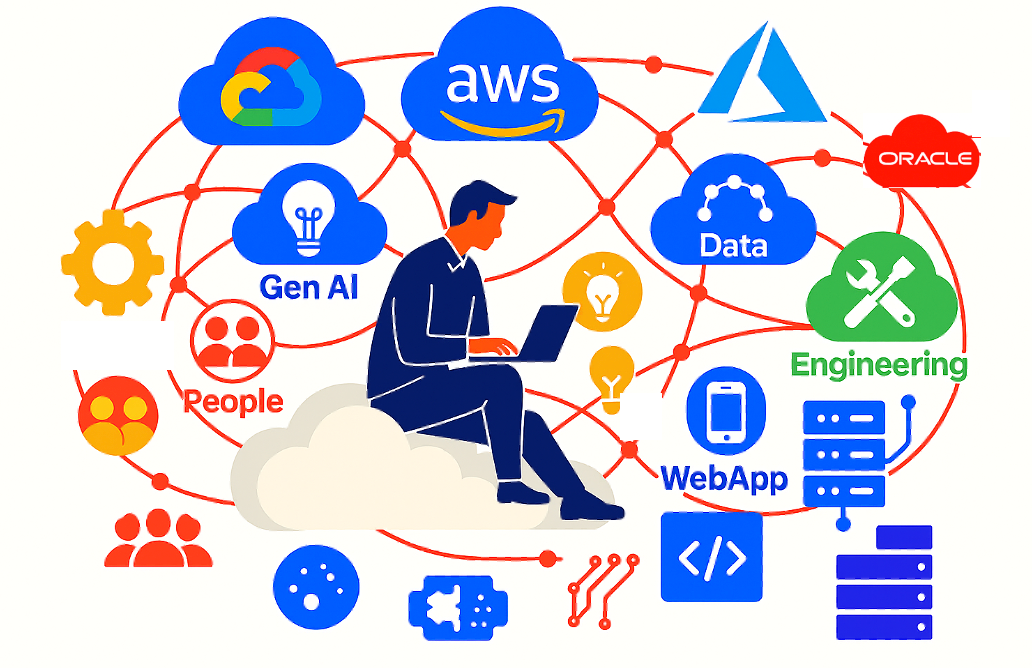
Hybrid multi-cloud has become the norm for enterprises because no single environment whether public cloud, private cloud, or on-premises can fully satisfy the demands for performance, compliance, cost efficiency, and resilience. Modern organisations run a wide range of workloads, operate under strict regulations, and need flexibility without being tied to one vendor, making a blended cloud approach the most practical and forward-looking solution.
The move toward hybrid multi-cloud isn’t just a passing trend, it’s become a strategic necessity. For most modern enterprises, putting everything with a single cloud provider introduces too many risks and constraints.
By blending private infrastructure (on-premises) with multiple public clouds, businesses achieve a level of control, resilience, and flexibility that no single environment can offer.
Avoiding Vendor Lock-in
Regulatory and Data Sovereignty
Global enterprises operate across regions with vastly different regulatory requirements, such as GDPR in Europe which makes compliance a constant challenge.
Reliability and Redundancy
Even the most reliable cloud providers experience outages. When your entire infrastructure depends on a single platform or region, any disruption can bring your business to a standstill.
"Best-of-Breed" services
Relying on one provider creates dependency risks in terms of pricing, outages, or roadmap changes. The biggest fear or risk for a company is being "trapped" by a single provider's pricing or proprietary technology.
- Portability: Using a multi-cloud strategy allows companies to move workloads if a provider raises prices or if their service quality drops.
- Negotiation Power: When you aren't tied to one vendor, you have better leverage for discounts.
Regulatory and Data Sovereignty
Global enterprises operate across regions with vastly different regulatory requirements, such as GDPR in Europe which makes compliance a constant challenge.
- Local data laws: Many countries mandate that certain data must remain within their borders. A multi‑cloud strategy allows organisations to choose cloud providers with data centers in the specific regions where they operate.
- Industry‑specific regulations: Sectors like government, finance, and healthcare often require sensitive workloads to stay on‑premises or within tightly controlled national boundaries. Hybrid architectures combining on‑prem infrastructure with public cloud, enable compliance without limiting scalability or innovation.
- Privacy protection: Highly sensitive or regulated data can remain in a private, on‑prem environment, while less sensitive applications and services run efficiently in the public cloud.
Reliability and Redundancy
Even the most reliable cloud providers experience outages. When your entire infrastructure depends on a single platform or region, any disruption can bring your business to a standstill.
- Failover resilience: A multi‑cloud architecture enables true high availability. If Provider A experiences an outage, critical workloads can automatically shift to Provider B, keeping services online.
- Risk reduction: By distributing workloads across multiple clouds, organisations eliminate the danger of a single point of failure and significantly improve overall business continuity.
"Best-of-Breed" services
Cloud providers aren't a "one-size-fits-all" solution. By leveraging a multi-cloud strategy, organisations can align specific business needs with each platform's unique strengths:
- Best‑of‑breed capabilities: A company might rely on Google Cloud for advanced AI and analytics, Azure for its deep integration with Microsoft enterprise tools, and AWS for unmatched scale and global footprint.
- Optimised performance: This approach lets teams choose the ideal service for each workload rather than settling for a one‑size‑fits‑all solution that’s merely "good enough."
Performance & Latency Optimisation
Enterprises can boost application performance by placing workloads closer to end users or key geographic regions, taking advantage of the global reach offered by multiple cloud providers.
Cost Optimisation & Predictability
Public cloud pricing can escalate quickly for steady, high‑volume workloads.
- A hybrid approach places predictable, long‑running workloads on‑premises for lower, more stable long‑term costs, while using the cloud only for burst capacity when needed.
- This reduces unexpected egress charges and avoids paying for over‑provisioned cloud resources.
The "Operating Model" Shift
To make this work, enterprises are moving toward Cloud Agnostic standard based tools like Kubernetes for orchestration or Terraform for infrastructure as code (IaC) or Spark for data processing. These tools allow developers to write code once and run it on any cloud, masking the underlying complexity. Hybrid multi-cloud isn’t the "simplest" architecture. it’s the most adaptable one for large, complex organisations dealing with regulation, legacy tech, and global scale.
Need further assistance?
How can we help ?
Brainstorming: Exploring fresh ideas or building on existing ones.
Problem Solving: Finding a way through a technical or logical hurdle.
Organisation: Bringing structure to your thoughts, plans, or information.
How can we help ?
Brainstorming: Exploring fresh ideas or building on existing ones.
Problem Solving: Finding a way through a technical or logical hurdle.
Organisation: Bringing structure to your thoughts, plans, or information.
Clarity:Breaking down complex ideas into clear, simple explanations.

As organisations accelerate their shift to cloud-native architectures, many are no longer relying on a single provider. Instead, they operate across multiple platforms public, private, and hybrid creating what’s known as a multi-cloud environment. While this approach offers flexibility, resilience, and vendor independence, it also introduces a sprawling attack surface. Traditional perimeter-based security models struggle to keep up. Cloud computing, remote work, mobile devices, and third-party integrations have dissolved the once-clear boundaries between "inside" and "outside" an organisation’s network. As a result, a new approach to cybersecurity has emerged: Zero Trust. By 2026, Zero Trust Architecture (ZTA) has transitioned from a buzzword to a mandatory framework for managing the complexities of multi-cloud security. What is Zero Trust ? Zero Trust is a security model built on a simple but powerful principle: never trust, always verify. Rather than assuming that anything inside a network is safe, Zero Trust requires continuous authentication, authorisation, and validation of every user, device, and workload—regardless of where it originates. This means that even if a user is already inside the network, they must still prove their identity and legitimacy every time they attempt to access systems or data. similar to someone inside office but still need ID card to open the doors. In a multi-cloud world, where systems are distributed across providers and geographies, this approach becomes essential rather than optional. Why Zero Trust Matters ? Traditional security models rely heavily on perimeter defenses like firewalls and VPNs. While these tools are still useful, they are no longer sufficient on their own. Cyber threats have evolved, attackers often gain access through compromised credentials or insider vulnerabilities, then move laterally within the network. Zero Trust addresses these challenges by: Reducing the risk of unauthorised access Limiting lateral movement within systems Enhancing visibility into user and device behavior Strengthening protection for sensitive data Core Principles of Zero Trust in Multi-Cloud A successful Zero Trust strategy typically rests on several foundational principles: 1. Identity as the New Perimeter In Zero Trust, identity replaces the traditional network perimeter. Every request must be authenticated using strong identity controls, such as multi-factor authentication (MFA) and adaptive access policies. In multi-cloud setups, this means federating identity across platforms so users can be verified consistently, regardless of where resources are hosted. 2. Least Privilege Access Users and services should only have access to what they absolutely need and nothing more. This minimises the blast radius if credentials are compromised. Implementing least privilege across clouds requires centralised policy management and continuous auditing of permissions. 3. Assume Breach Zero Trust operates under the assumption that threats may already exist within the network. This mindset drives continuous monitoring and rapid response. 4. Verify Explicitly Every access request must be authenticated and authorized using all available data points, including user identity, device health, location, and behavior patterns. 5. Continuous Monitoring and Verification Trust is never permanent. Even after access is granted, behavior must be continuously monitored for anomalies. This includes: Real-time threat detection Behavioral analytics Automated response mechanisms 6. Micro-Segmentation Instead of one large, flat network, Zero Trust divides environments into smaller, isolated segments. Each segment enforces its own access controls. In multi-cloud environments, micro-segmentation prevents lateral movement between workloads—even across different providers. 7. Device and Workload Security Every endpoint, whether it’s a laptop, container, or virtual machine, It must be verified before accessing resources. Security checks may include: Device posture validation Patch level verification Runtime workload protection Key Components of a Zero Trust Strategy Implementing Zero Trust involves a combination of technologies, policies, and cultural changes: 1. Identity and Access Management (IAM) Strong authentication mechanisms such as multi-factor authentication (MFA), ensure that users are who they claim to be. 2. Device Security Only trusted and compliant devices should be allowed to access resources. This includes enforcing security updates and endpoint protection. 3. Network Segmentation Breaking the network into smaller segments prevents attackers from moving freely if they gain access. 4. Data Protection Sensitive data should be encrypted, classified, and monitored to prevent unauthorised access or leakage. 5. Continuous Monitoring and Analytics Real-time monitoring helps detect unusual behavior and respond quickly to potential threats. The Strategic Benefits of Zero Trust in Multi‑Cloud Organisations that embrace Zero Trust gain more than security. Reduced breach impact through segmentation and least privilege Faster cloud adoption with consistent controls Improved compliance across jurisdictions Operational resilience even when one cloud provider experiences issues Better user experience with modern identity solutions Zero Trust becomes a business enabler, not a bottleneck. Practical Steps to Implement Zero Trust Across Clouds A realistic roadmap looks like this: Start with identity: unify IAM and enforce MFA everywhere. Map your data flows: understand what moves between clouds. Segment your networks and workloads: shrink the attack surface. Adopt cloud‑agnostic security tooling: avoid vendor lock‑in. Automate everything: policy enforcement, access reviews, threat response. Continuously measure maturity: Zero Trust is a journey, not a destination. Security Without Borders Multi‑cloud is the new normal. The organisations that thrive in it will be the ones that treat security as a distributed, adaptive, identity‑driven discipline. Zero Trust provides the blueprint for a world where data flows across borders, clouds, and platforms, without sacrificing control. By shifting the focus from location to identity, from trust to verification, organizations can build a security posture that truly has no borders. Need further assistance? How can we help ? Brainstorming: Exploring fresh ideas or building on existing ones. Problem Solving: Working through technical, logical, or creative challenges. Organisation: Bringing structure to your thoughts, plans, or information. Clarity: Breaking down complex ideas into clear, simple explanations. Implementation: Helping you turn ideas into actionable steps, plans, or real-world execution.

As cloud adoption accelerates, organisations are gaining unprecedented flexibility but often at the cost of spiraling and unpredictable spend. This is where FinOps (Financial Operations) comes in: a cultural and operational framework that brings financial accountability to the variable spend model of the cloud. Implementing FinOps isn’t just about cost-cutting; it’s about enabling teams to make smarter, data-driven decisions that balance speed, cost, and quality. Implementing FinOps (Financial Operations) is not about installing a tool. it’s about changing how engineering, finance, and business teams work together around cloud spend. If you treat it like a cultural + process shift rather than just cost-cutting, it works much better. Here’s a practical way to roll it out in your team or organisation. Understanding the FinOps Mindset At its core, FinOps is a collaborative practice that unites engineering, finance, and business teams. Instead of treating cloud costs as a static expense, FinOps encourages continuous optimisation and shared ownership. Engineers gain visibility into the financial impact of their decisions, while finance teams better understand the dynamic nature of cloud usage. To implement FinOps effectively, your organisation must embrace transparency, accountability, and cross-functional collaboration. This cultural shift is just as important as any tooling or process you introduce. Step 1: Understand and Research Your Current State This is your foundation. Before introducing any FinOps practices, you need a clear picture of where you stand today and what challenges you’re trying to solve. Start by analysing your current cloud spend, usage patterns, and key cost drivers across accounts, services, and teams. Look beyond total cost—focus on where and why money is being spent. Next, identify inefficiencies such as idle resources, over-provisioning, or inconsistent (or missing) tagging. These are often the quickest opportunities for improvement and can highlight gaps in governance or visibility. Finally, gather baseline data to support decision-making and measure progress over time. This baseline will help you build a compelling FinOps strategy and demonstrate value to stakeholders. This step aligns with the Research stage described by the FinOps Foundation, where organizations establish visibility and understanding before taking action. Step 2: Establish Ownership and Accountability Once you understand your current state, the next step is to define clear ownership of cloud costs. FinOps works best when responsibility is shared rather than centralised. Assign accountability to engineering teams for the resources they provision, while finance teams provide oversight, budgeting guidance, and governance. Consider forming a FinOps function or appointing FinOps champions within teams to bridge the gap between technical and financial stakeholders. Clear ownership ensures that cost management becomes part of everyday decision-making rather than an afterthought. Step 3: Gain Visibility into Cloud Spend You can’t optimise what you can’t see. Implement tools and dashboards that provide real-time insights into cloud usage and costs. Break down spending by team, project, or environment to identify patterns and anomalies. Tagging is critical here. Ensure resources are consistently labeled so costs can be accurately attributed. Without proper tagging, visibility—and therefore accountability—breaks down. Step 4: Set Budgets and Forecasts Introduce budgeting practices that align with business goals. Work with stakeholders to define acceptable spending levels and create forecasts based on historical data and expected growth. Unlike traditional IT budgets, cloud budgets should be flexible and revisited frequently. Encourage teams to treat budgets as guardrails rather than rigid limits. Step 5: Drive Cost Optimisation With visibility and accountability in place, you can begin optimising. This includes: Rightsizing resources (e.g., scaling down over-provisioned instances) Eliminating unused or idle assets Leveraging pricing models like reserved or spot instances Automating start/stop schedules for non-production environments Optimisation should be continuous, not a one-time exercise. Step 6: Implement Governance and Policies Establish policies to guide spending without slowing innovation. This might include approval workflows for large deployments, cost anomaly alerts, or automated enforcement of tagging standards. The goal is to create lightweight governance that empowers teams while maintaining control. Step 7: Foster a Culture of Accountability FinOps succeeds when everyone feels responsible for cost efficiency. Share reports regularly, celebrate wins, and highlight areas for improvement. Encourage teams to experiment and learn from their spending patterns. Education is key, provide training so teams understand both the technical and financial aspects of cloud usage. Step 8: Iterate and Improve FinOps is a journey, not a destination. As your organization evolves, so will your cloud usage and financial practices. Regularly review your processes, tools, and metrics to ensure they remain effective. Solicit feedback from teams and refine your approach to better align with business objectives. Final Thoughts Implementing FinOps requires more than just tools, it demands a shift in mindset and collaboration across your organisation. By focusing on visibility, accountability, and continuous improvement, you can turn cloud spending from a source of concern into a strategic advantage. Done right, FinOps doesn’t just reduce costs. it empowers teams to innovate with confidence, knowing they are making financially responsible decisions. Need further assistance? How can we help ? Brainstorming: Exploring fresh ideas or building on existing ones. Problem Solving: Working through technical, logical, or creative challenges. Organisation: Bringing structure to your thoughts, plans, or information. Clarity: Breaking down complex ideas into clear, simple explanations. Implementation: Helping you turn ideas into actionable steps, plans, or real-world execution.