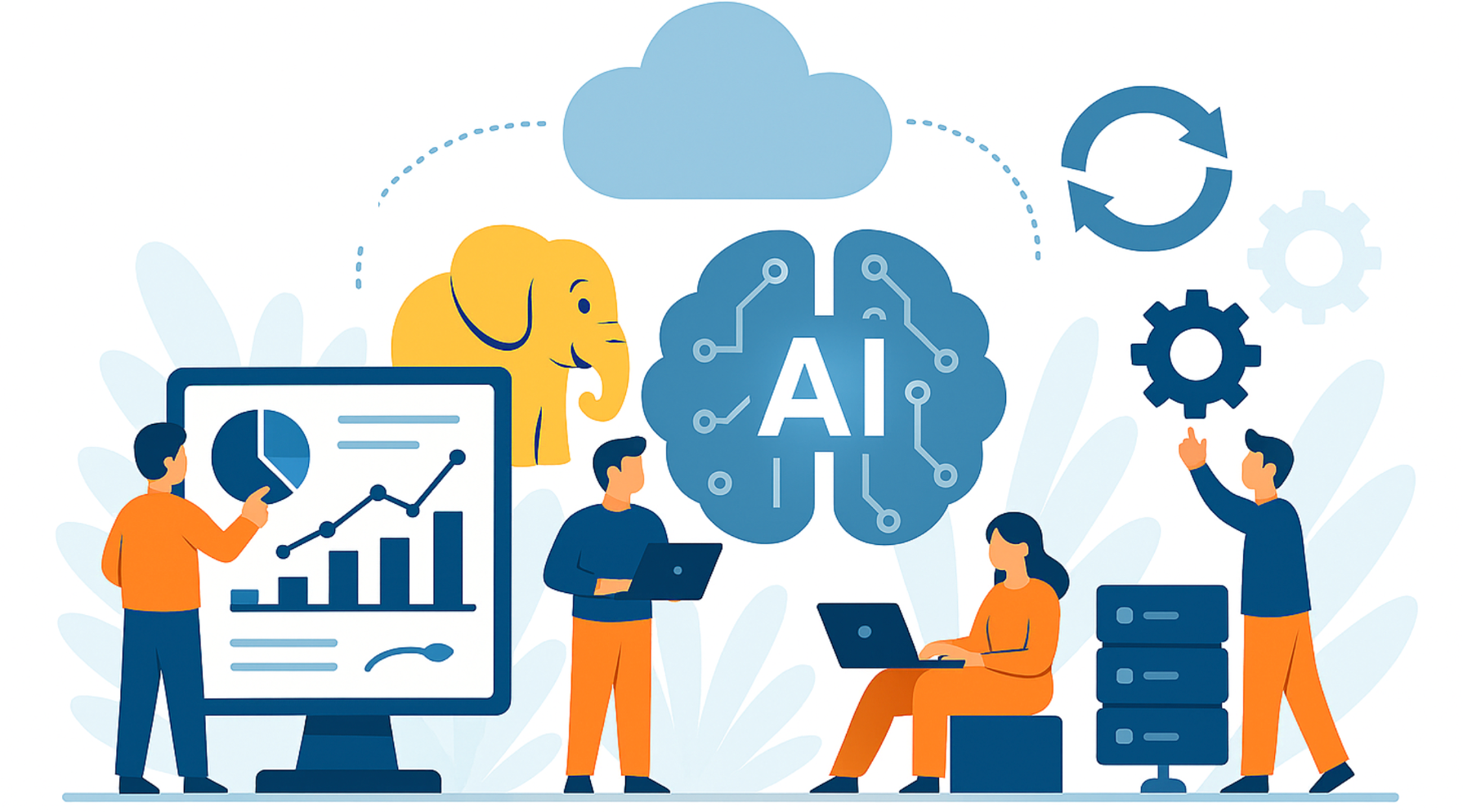
AI Computing Trends 2026

AI Cloud Computing Trends 2025

AI computing in 2026 is driven by efficiency and marked by a clear shift from AI as a tool to AI as a partner, enabled by stronger infrastructure, autonomous agents, and responsible governance. Key themes include optimised AI infrastructure, edge and domain‑specific models, agentic systems, and the early convergence of quantum and physical AI. Organisations are embedding AI deeper into workflows, scaling multimodal capabilities, and reinforcing security as AI becomes central to real‑world decision-making.

Rise of "Agentic AI" and "Multi-Agent " systems

AI Agents Become Digital Coworkers. AI agents are evolving from passive assistants to active collaborators. They manage workflows, generate content, analyse data, and execute tasks with minimal supervision.
  • AI is evolving from chatbots into autonomous agents that perform tasks end-to-end.These agents can plan, execute workflows, and collaborate with humans like teammates.
  • Agents are embedded directly into workplaces, labs, and infrastructure, acting within human systems rather than waiting for prompts.
  • Businesses are moving toward multi-agent systems that handle entire processes (not just single tasks)
Impact:
  • Smaller teams achieve more
  • Automation shifts from "assistive" to "operational"
  • Productivity skyrockets
  • Organisations that design human–AI collaboration workflows gain a competitive edge.

Shift to domain-specific language models & smaller models

Generic LLMs are being replaced by specialised models trained on industry-specific data. These offer higher accuracy and better regulatory compliance while requiring less computational power.

 These models are:
  • Cheaper to run
  • More accurate for specific tasks
  • Easier to deploy at scale
Impact:
  • Healthcare, finance, legal, retail each get tailored AI
  • Better ROI vs "one-size-fits-all" models

Trust, safety & governance become essential

As AI systems move from just assisting humans to actually making or influencing decisions (in hiring, healthcare, finance, etc.), people need to trust those systems. That means companies can’t treat safety as optional anymore. it becomes critical.

Bias : AI can unintentionally reinforce unfair patterns in the data it was trained on. When AI influences hiring, lending, healthcare, or policing, even small biases can have huge consequences.

Hallucinations : Large models sometimes generate confident but incorrect information. When AI is used for critical tasks, these hallucinations become a real risk.

Security Risks: More AI means more attack surfaces. Adversarial prompts, data poisoning, and model theft all raise the stakes for robust security.

To address these concerns, the AI world is shifting toward stronger guardrails and transparency.

Explainable AI: People want to understand why an AI made a decision. Explainability helps build trust and allows humans to challenge or correct the system.

Human Oversight: AI is not being left to run wild. Humans remain in the loop for high‑impact decisions, ensuring accountability and ethical judgment. AI assists, but a person reviews or approves critical outcomes.

Regulatory Frameworks: Governments and organisations create rules and standards for AI use. Governments are stepping in with clearer rules around safety, transparency, data use, and accountability. Compliance is becoming a core part of AI development.


Hybrid computing (AI + cloud + edge + quantum)

Future AI systems will blend multiple computing paradigms:
  • Cloud computing
  • Edge AI ( for real-time processing)
  • High‑performance supercomputing
  • Early-stage quantum technologies
Impact:
  • Faster, more distributed intelligence
  • Breakthroughs in science, simulation, and complex problem‑solving


Physical AI & robotics expansion

AI is increasingly stepping into the physical world through robotics, manufacturing, and autonomous systems. AI is moving into the real world:
  • Robotics
  • Manufacturing
  • Autonomous systems
Impact:
  • Digital intelligence (Digital AI) evolves into embodied intelligence (Embodied AI)
  • Automation expands beyond software into physical labour


Shift from experimentation to Proven the value and ROI

The era of AI experimentation is ending. Organisations now demand measurable value.

Companies now prioritise:
  • Cost efficiency
  • Measurable outcomes
  • Business impact
Impact:
  • AI projects must justify spending
  • Budget shifts toward practical deployments

Summary: AI Becomes a Strategic Partner:
  
The AI landscape in 2026 is undergoing a structural transformation. AI is evolving from simple chat interfaces into autonomous, agent‑driven systems capable of planning, acting, and collaborating as true digital coworkers. Organisations are moving from experimentation to full operational deployment, automating entire workflows and embracing smaller, domain‑specific models that deliver higher accuracy and lower cost.

As AI takes on more consequential roles, trust, safety, and governance become essential to managing risks like bias, hallucinations, and security vulnerabilities. This evolution is powered by hybrid computing across cloud, edge, supercomputing, and emerging quantum technologies, while robotics brings AI into the physical world.

Ultimately, AI in 2026 is not just a technology—it’s a strategic capability reshaping how work happens, how decisions are made, and how industries operate.

 
April 22, 2026
As organisations accelerate their shift to cloud-native architectures, many are no longer relying on a single provider. Instead, they operate across multiple platforms public, private, and hybrid creating what’s known as a multi-cloud environment. While this approach offers flexibility, resilience, and vendor independence, it also introduces a sprawling attack surface. Traditional perimeter-based security models struggle to keep up. Cloud computing, remote work, mobile devices, and third-party integrations have dissolved the once-clear boundaries between "inside" and "outside" an organisation’s network. As a result, a new approach to cybersecurity has emerged: Zero Trust. By 2026, Zero Trust Architecture (ZTA) has transitioned from a buzzword to a mandatory framework for managing the complexities of multi-cloud security. What is Zero Trust ? Zero Trust is a security model built on a simple but powerful principle: never trust, always verify. Rather than assuming that anything inside a network is safe, Zero Trust requires continuous authentication, authorisation, and validation of every user, device, and workload—regardless of where it originates. This means that even if a user is already inside the network, they must still prove their identity and legitimacy every time they attempt to access systems or data. similar to someone inside office but still need ID card to open the doors. In a multi-cloud world, where systems are distributed across providers and geographies, this approach becomes essential rather than optional. Why Zero Trust Matters ? Traditional security models rely heavily on perimeter defenses like firewalls and VPNs. While these tools are still useful, they are no longer sufficient on their own. Cyber threats have evolved, attackers often gain access through compromised credentials or insider vulnerabilities, then move laterally within the network. Zero Trust addresses these challenges by: Reducing the risk of unauthorised access Limiting lateral movement within systems Enhancing visibility into user and device behavior Strengthening protection for sensitive data Core Principles of Zero Trust in Multi-Cloud A successful Zero Trust strategy typically rests on several foundational principles: 1. Identity as the New Perimeter In Zero Trust, identity replaces the traditional network perimeter. Every request must be authenticated using strong identity controls, such as multi-factor authentication (MFA) and adaptive access policies. In multi-cloud setups, this means federating identity across platforms so users can be verified consistently, regardless of where resources are hosted. 2. Least Privilege Access Users and services should only have access to what they absolutely need and nothing more. This minimises the blast radius if credentials are compromised. Implementing least privilege across clouds requires centralised policy management and continuous auditing of permissions. 3. Assume Breach Zero Trust operates under the assumption that threats may already exist within the network. This mindset drives continuous monitoring and rapid response. 4. Verify Explicitly Every access request must be authenticated and authorized using all available data points, including user identity, device health, location, and behavior patterns. 5. Continuous Monitoring and Verification Trust is never permanent. Even after access is granted, behavior must be continuously monitored for anomalies. This includes: Real-time threat detection Behavioral analytics Automated response mechanisms 6. Micro-Segmentation Instead of one large, flat network, Zero Trust divides environments into smaller, isolated segments. Each segment enforces its own access controls. In multi-cloud environments, micro-segmentation prevents lateral movement between workloads—even across different providers. 7. Device and Workload Security Every endpoint, whether it’s a laptop, container, or virtual machine, It must be verified before accessing resources. Security checks may include: Device posture validation Patch level verification Runtime workload protection Key Components of a Zero Trust Strategy Implementing Zero Trust involves a combination of technologies, policies, and cultural changes: 1. Identity and Access Management (IAM) Strong authentication mechanisms such as multi-factor authentication (MFA), ensure that users are who they claim to be. 2. Device Security Only trusted and compliant devices should be allowed to access resources. This includes enforcing security updates and endpoint protection. 3. Network Segmentation Breaking the network into smaller segments prevents attackers from moving freely if they gain access. 4. Data Protection Sensitive data should be encrypted, classified, and monitored to prevent unauthorised access or leakage. 5. Continuous Monitoring and Analytics Real-time monitoring helps detect unusual behavior and respond quickly to potential threats. The Strategic Benefits of Zero Trust in Multi‑Cloud Organisations that embrace Zero Trust gain more than security. Reduced breach impact through segmentation and least privilege Faster cloud adoption with consistent controls Improved compliance across jurisdictions Operational resilience even when one cloud provider experiences issues Better user experience with modern identity solutions Zero Trust becomes a business enabler, not a bottleneck. Practical Steps to Implement Zero Trust Across Clouds A realistic roadmap looks like this: Start with identity: unify IAM and enforce MFA everywhere. Map your data flows: understand what moves between clouds. Segment your networks and workloads: shrink the attack surface. Adopt cloud‑agnostic security tooling: avoid vendor lock‑in. Automate everything: policy enforcement, access reviews, threat response. Continuously measure maturity: Zero Trust is a journey, not a destination. Security Without Borders Multi‑cloud is the new normal. The organisations that thrive in it will be the ones that treat security as a distributed, adaptive, identity‑driven discipline. Zero Trust provides the blueprint for a world where data flows across borders, clouds, and platforms, without sacrificing control. By shifting the focus from location to identity, from trust to verification, organizations can build a security posture that truly has no borders. Need further assistance? How can we help ? Brainstorming: Exploring fresh ideas or building on existing ones. Problem Solving: Working through technical, logical, or creative challenges. Organisation: Bringing structure to your thoughts, plans, or information. Clarity: Breaking down complex ideas into clear, simple explanations. Implementation: Helping you turn ideas into actionable steps, plans, or real-world execution.
April 22, 2026
As cloud adoption accelerates, organisations are gaining unprecedented flexibility but often at the cost of spiraling and unpredictable spend. This is where FinOps (Financial Operations) comes in: a cultural and operational framework that brings financial accountability to the variable spend model of the cloud. Implementing FinOps isn’t just about cost-cutting; it’s about enabling teams to make smarter, data-driven decisions that balance speed, cost, and quality. Implementing FinOps (Financial Operations) is not about installing a tool. it’s about changing how engineering, finance, and business teams work together around cloud spend. If you treat it like a cultural + process shift rather than just cost-cutting, it works much better. Here’s a practical way to roll it out in your team or organisation. Understanding the FinOps Mindset At its core, FinOps is a collaborative practice that unites engineering, finance, and business teams. Instead of treating cloud costs as a static expense, FinOps encourages continuous optimisation and shared ownership. Engineers gain visibility into the financial impact of their decisions, while finance teams better understand the dynamic nature of cloud usage. To implement FinOps effectively, your organisation must embrace transparency, accountability, and cross-functional collaboration. This cultural shift is just as important as any tooling or process you introduce. Step 1: Understand and Research Your Current State This is your foundation. Before introducing any FinOps practices, you need a clear picture of where you stand today and what challenges you’re trying to solve. Start by analysing your current cloud spend, usage patterns, and key cost drivers across accounts, services, and teams. Look beyond total cost—focus on where and why money is being spent. Next, identify inefficiencies such as idle resources, over-provisioning, or inconsistent (or missing) tagging. These are often the quickest opportunities for improvement and can highlight gaps in governance or visibility. Finally, gather baseline data to support decision-making and measure progress over time. This baseline will help you build a compelling FinOps strategy and demonstrate value to stakeholders. This step aligns with the Research stage described by the FinOps Foundation, where organizations establish visibility and understanding before taking action. Step 2: Establish Ownership and Accountability Once you understand your current state, the next step is to define clear ownership of cloud costs. FinOps works best when responsibility is shared rather than centralised. Assign accountability to engineering teams for the resources they provision, while finance teams provide oversight, budgeting guidance, and governance. Consider forming a FinOps function or appointing FinOps champions within teams to bridge the gap between technical and financial stakeholders. Clear ownership ensures that cost management becomes part of everyday decision-making rather than an afterthought. Step 3: Gain Visibility into Cloud Spend You can’t optimise what you can’t see. Implement tools and dashboards that provide real-time insights into cloud usage and costs. Break down spending by team, project, or environment to identify patterns and anomalies. Tagging is critical here. Ensure resources are consistently labeled so costs can be accurately attributed. Without proper tagging, visibility—and therefore accountability—breaks down. Step 4: Set Budgets and Forecasts Introduce budgeting practices that align with business goals. Work with stakeholders to define acceptable spending levels and create forecasts based on historical data and expected growth. Unlike traditional IT budgets, cloud budgets should be flexible and revisited frequently. Encourage teams to treat budgets as guardrails rather than rigid limits. Step 5: Drive Cost Optimisation With visibility and accountability in place, you can begin optimising. This includes: Rightsizing resources (e.g., scaling down over-provisioned instances) Eliminating unused or idle assets Leveraging pricing models like reserved or spot instances Automating start/stop schedules for non-production environments Optimisation should be continuous, not a one-time exercise. Step 6: Implement Governance and Policies Establish policies to guide spending without slowing innovation. This might include approval workflows for large deployments, cost anomaly alerts, or automated enforcement of tagging standards. The goal is to create lightweight governance that empowers teams while maintaining control. Step 7: Foster a Culture of Accountability FinOps succeeds when everyone feels responsible for cost efficiency. Share reports regularly, celebrate wins, and highlight areas for improvement. Encourage teams to experiment and learn from their spending patterns. Education is key, provide training so teams understand both the technical and financial aspects of cloud usage. Step 8: Iterate and Improve FinOps is a journey, not a destination. As your organization evolves, so will your cloud usage and financial practices. Regularly review your processes, tools, and metrics to ensure they remain effective. Solicit feedback from teams and refine your approach to better align with business objectives. Final Thoughts Implementing FinOps requires more than just tools, it demands a shift in mindset and collaboration across your organisation. By focusing on visibility, accountability, and continuous improvement, you can turn cloud spending from a source of concern into a strategic advantage. Done right, FinOps doesn’t just reduce costs. it empowers teams to innovate with confidence, knowing they are making financially responsible decisions. Need further assistance? How can we help ? Brainstorming: Exploring fresh ideas or building on existing ones. Problem Solving: Working through technical, logical, or creative challenges. Organisation: Bringing structure to your thoughts, plans, or information. Clarity: Breaking down complex ideas into clear, simple explanations. Implementation: Helping you turn ideas into actionable steps, plans, or real-world execution.
Show More